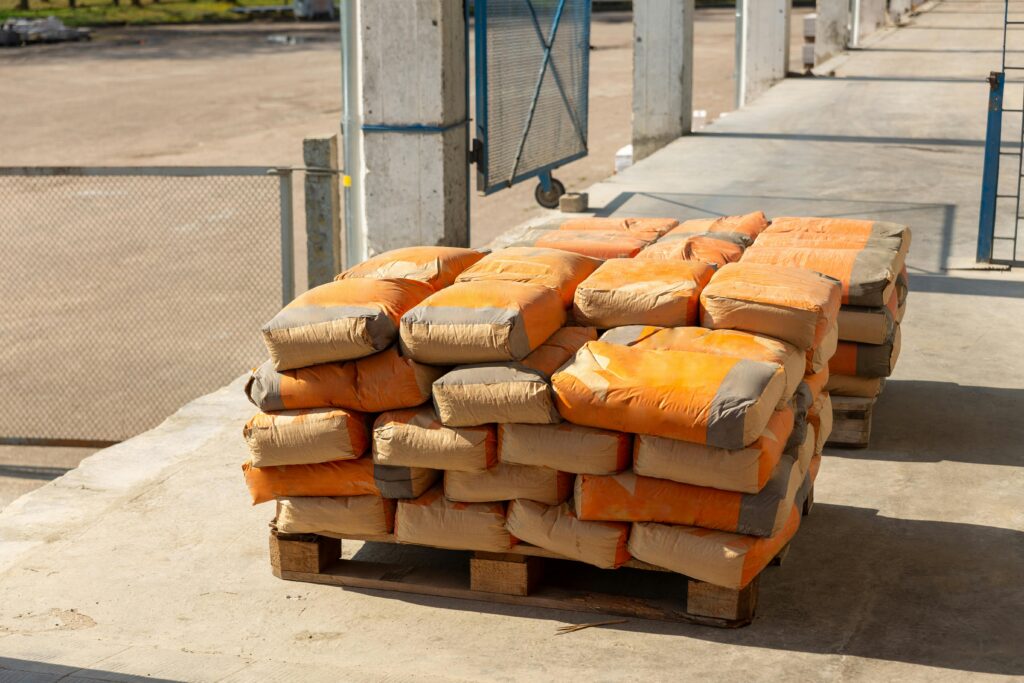
Cement is a defined as a finely ground powder that when mixed with water, a chemical reaction, known as hydration, takes place which then produces a very hard and binding medium for the other solid particles. It is often referred to as the binding medium and performs the following functions in a matrix.
It is the most expensive ingredient in a concrete design mix.
Setting time of cement refers to the time required for cement paste to lose its plasticity and become rigid after mixing with water. It is an important property because it determines the time available for mixing, transporting, placing, compacting, and finishing concrete or mortar.
- Cement gives the hardened matrix the compressive strength and durability.
- Cement provides the lubrication of a fresh plastic matrix hence improved its workability.
- Cement fills up the air voids in between the aggregate particles, and this ensures that the final a hardened matrix is more water-tight.
In modern construction, different types of cement are manufactured to suit specific engineering needs such as rapid strength gain, resistance to chemicals, waterproofing, decorative finishes, and mass concrete works.
a) Manufacturing Processes of Cement
Cement is mainly manufactured using two methods:
Wet Process
In the wet process, limestone and clay are mixed with water to form slurry before being heated in a rotary kiln. The clinker produced is cooled and ground with gypsum to form cement.
Advantages of Wet Process
- Better mixing of raw materials
- Easier chemical composition control
Disadvantages of Wet Process
- High fuel consumption
- More expensive compared to dry process
Dry Process
In the dry process, the raw materials are dried and then ground into a fine powder. This dry powder, known as raw meal, is then taken into the rotary kiln.
Advantages of Dry Process
- The Process consumes lesser fuel since the amount of moisture content in the raw meal to be evaporated is less.
- The process is more economical since the economical due to lesser fuel costs.
- The Process is faster since the raw material does not undergo longer evaporation phase to get rid of the moisture content.
Disadvantages of Dry Process
- The dry process requires efficient dust control systems.
b) Types of Cement and Their Applications
-
Ordinary Portland Cement (OPC)
Ordinary Portland Cement (OPC) is the most widely used cement in the world. It is suitable for general concrete construction works.
Advantages of OPC
- It offers high strength development.
- It is the most easily available type of cement.
- It is suitable for most construction projects
- It is cost-effective as it is cheaper compared to other types of cement.
Uses and Applications
- Residential buildings
- Bridges
- Pavements
- Masonry works
- Reinforced concrete structures
2. Portland Pozzolana Cement (PPC)
Portland Pozzolana Cement is produced by mixing pozzolanic clinker materials with Portland cement. It is also produced by adding pozzolana with the addition of gypsum or calcium sulfate or by intimately and uniformly blending Portland cement and fine pozzolana.
The Portland Pozzolana Cement is known for its higher resistance to various chemical attacks than Ordinary Portland Cement.
Advantages of Pozzolana Cement
- High resistance to chemical attacks
- Improved durability
- Reduced heat of hydration
- Better long-term strength
Uses and Applications
- Construction of Marine structures
- Dam construction
- Sewage concreting works.
- Underwater concreting
- Bridges and piers construction
3. Rapid Hardening Cement
Rapid hardening cement develops high early strength due to finer grinding and higher Lime and C3S content. The early strength it develops within 3 days is the same strength that OPC cement would develop at 7 days. Thus, this allows for the formwork to be stripped off much earlier than when OPC has been used in the design mix.
Advantages of Rapid Hardening Cement
- It gains strength much earlier than OPC
- It enables faster construction.
- It enables early removal of formwork.
- It leads to reduced construction time.
Uses and Applications
- It is used in the Road construction
- Used in the making of Precast concrete units
- It is deal for emergency repair works
4. Quick Setting Cement
Quick setting cement sets very rapidly compared to rapid hardening cement but overtime, it has the same strength gain as the OPC. In both cases, the formworks can also be stripped much earlier.
Advantages of Quick Setting Cement
- Fast setting time
- Suitable for urgent construction works
- Useful in wet conditions
Uses and Applications
- Applied in the underwater construction.
- Applied in the construction of water structures with running water.
- It is also recommended for emergency concrete repairs.
- It is ideal for projects with a short-duration.
5. Low Heat Cement
Low heat cement produces less heat during hydration because it contains lower tri-calcium aluminate content. During manufacturing process, this is achieved by increasing the di-calcium silicate content while maintaining the tri-calcium silicate below 6%. Additionally, it has a greater setting time when compared to OPC.
Advantages of Low Heat Cement
- It reduces thermal cracking due to lower heat of hydration generated.
- It enhances the durability of Mass concrete structures.
- It offers better sulfate resistance.
Uses and Applications
- Gravity dams
- Massive foundations
- Retaining structures
- Large concrete pours
6. Sulfate Resisting Cement
This cement has reduced Tri-Calcium Aluminate(C3A) and Tetra-Calcium Alumina Ferrite(C4AF) content. Hence, it is specially designed to resist sulfate attacks from soil and groundwater.
Advantages of Sulphate Resisting Cement
- It possesses high sulfate resistance.
- It offers improved durability in aggressive chemical environments.
- It enhances a longer service life of the concrete structure.
Uses and Applications
- Canal linings
- Culverts
- Retaining walls
- Foundations in sulfate-rich soils
- Sewage treatment plants
7. Blast Furnace Slag Cement
Blast furnace slag cement is produced by grinding clinker with slag (about 60%) obtained from steel manufacturing.
Advantages of Blast Furnace Slag Cement
- It is more economical in heat prone environments.
- It offers improved durability.
- It generates lower heat of hydration.
Uses and Applications
- It is suitable for mass concrete works and marine construction.
8. High Alumina Cement
High alumina cement is made from bauxite and lime and grinding and mixing it with clinker. It has a develops strength rapidly and has an initial and final setting time of 3 hours and 5 hours respectively.
Advantages of High Alumina Cement
- It gains strength rapidly.
- It offers excellent resistance to high temperatures, Acidity and frost.
Uses and Applications
- It is used in the construction of refractory concrete
- It is recommended for Industrial furnaces and chemical plants
- It is suitable for Cold weather concreting.
9. White Cement
White cement is manufactured using raw materials free from iron oxide. Hence it maintains its white color.
Advantages of White Cement
- It presents an attractive and aesthetic appearance in all finishes.
- It is ideal for most decorative works.
Uses and Applications
- Used in architectural finishes such as Terrazzo Flooring, Swimming Pools and ornamental concrete products.
10. Colored Cement
Colored cement is produced by adding mineral pigments, about 5-10%, to Ordinary Portland Cement.
Advantages of Colored Cement
- It presents a decorative appeal on its structures.
- It has a wide variety of colors to choose from for architectural finishes.
Uses and Applications
- It is used for decorative flooring and architectural finishes in pavement construction and landscaping projects.
11. Air Entraining Cement
Air entraining cement contains air-entraining agents such as glues, resins, sodium salts of sulphates etc. during manufacturing process. This addition improves the workability and frost resistance.
Advantages of Air Entraining Cement
- It offers better workability.
- It possesses a high freeze-thaw resistance than OPC.
- It is ideal for lower water-cement ratio design mixes.
Uses and Applications
- It is suitable for cold region construction and highway concreting works.
- It is recommended for concrete that will be exposed to frost.
12. Expansive Cement
Expansive cement expands slightly during and after hardening and minimizes shrinkage.
Advantages of Expansive Cement
- It reduces cracking due to lower shrinkage.
- Improves dimensional stability of the structure.
- It is good for grouting works.
Uses and Applications
- It is used for grouting anchor bolts.
- It is applied in the construction of Pre-stressed concrete ducts and Water-retaining structures.
- It is also recommended for Repair works.
13. Hydrographic Cement
Hydrographic cement contains water-repelling chemicals. It resists moisture penetration and has a higher workability and strength than OPC.
Advantages of Hydrographic Cement
- It offers higher water-resistant.
- It possesses high strength.
- It is suitable for constructing in wet conditions.
Uses and Applications
-
- It is applied in the construction of water structures and monsoon construction
- It is also recommended for construction of Basements where there is higher exposure of concrete to ground water.
- It is applied in waterproof concrete works
Cement plays a critical role in the strength, durability, and performance of concrete structures. Understanding the different types of cement, their advantages, and applications helps engineers, contractors, and builders select the most suitable material for each project.